Easy Pulled Candy
Homemade Saltwater Taffy Recipe is the kind of candy project that feels both nostalgic and wildly satisfying. It turns a bubbling pot of sugar, corn syrup, and butter into a glossy, chewy treat that looks like it came straight from a beachside candy shop.
What makes Homemade Saltwater Taffy Recipe so special is the transformation. You start with a hot syrup, then pull it, stretch it, twist it, and cut it until it becomes that soft, chewy candy everyone recognizes right away.
I love recipes like this because they feel playful but still teach real kitchen technique. Homemade Saltwater Taffy Recipe is not just about candy. It is also about temperature, timing, texture, and the fun of making something by hand that most people only buy wrapped in a bag.
Hi, I’m Chef Adriana, and I always enjoy old-fashioned sweets that feel both practical and magical. Saltwater taffy has that charm because it looks whimsical, tastes familiar, and turns a basic candy base into something giftable and memorable.
The first time I made taffy at home, I was surprised by how much the pulling stage changed the candy. The gloss turned pearly, the rope lightened in color, and the whole batch suddenly looked like real boardwalk candy instead of a pot of hot syrup.
If you love crafting old-fashioned, giftable confections from scratch, you must also try our homemade english toffee recipe. It has a completely different texture, but it delivers the same homemade candy satisfaction that makes projects like this so fun.
Table of Contents
Table of Contents
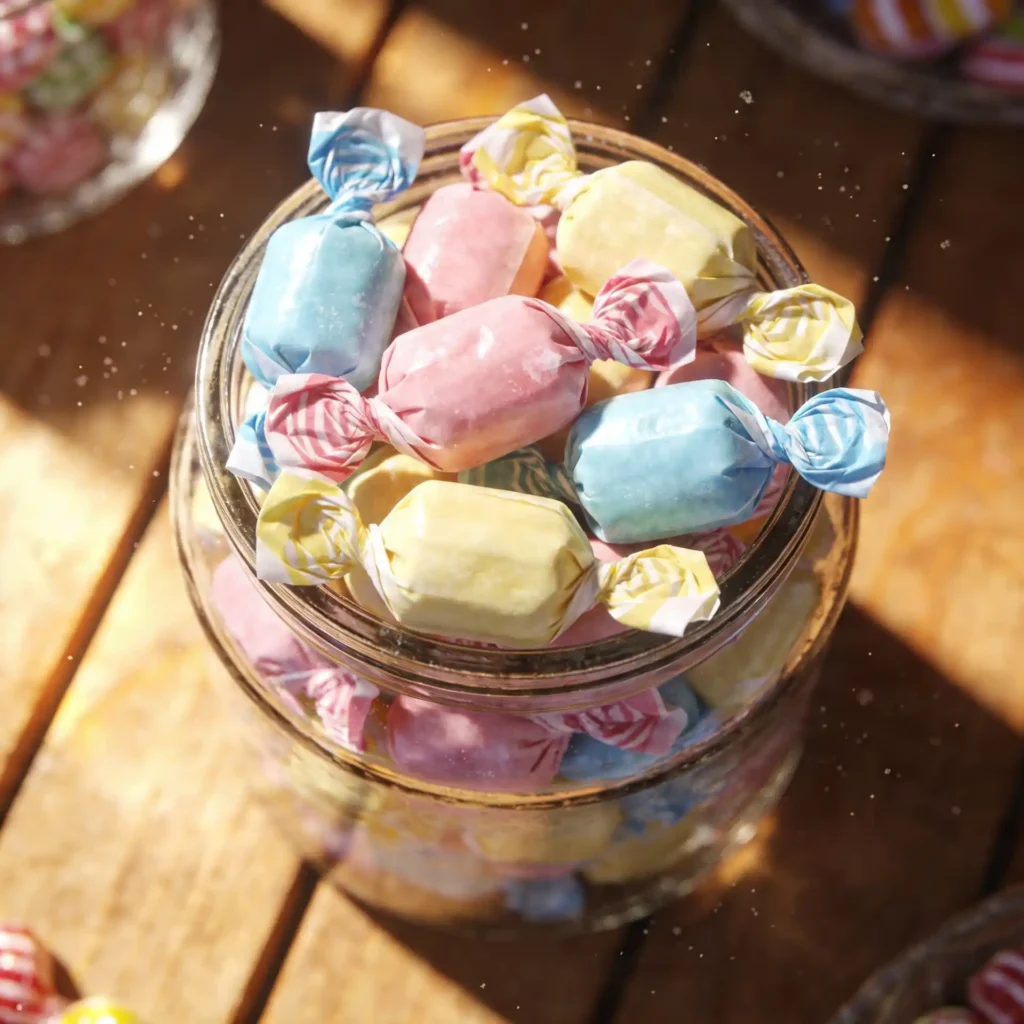
Why Homemade Saltwater Taffy Is a Nostalgic Classic
The Boardwalk History: Why Is It Called “Saltwater”?
Homemade Saltwater Taffy Recipe carries a name that sounds strange until you know the story behind it. Despite the name, real ocean water does not go into the candy, and that is one of the first myths worth clearing up.
The “saltwater” name came from old boardwalk candy culture, not from literal seawater as an ingredient. The candy became linked with coastal shops, beach vacations, striped boxes, and the kind of sweet that people carried home as a souvenir.
That history matters because it explains why saltwater taffy feels so nostalgic. It is not just candy. It is also wrapped up in the idea of summer trips, boardwalk shops, glass candy jars, and colorful twisted wrappers.
Salt still matters in the recipe, of course. It simply works like it does in many sweets by sharpening flavor and balancing the sweetness of the corn syrup and sugar base.
That small salty note is one reason Homemade Saltwater Taffy Recipe tastes more rounded than plain pulled sugar candy. Without it, the sweetness can feel flatter and less interesting.
I like that this candy feels old-fashioned without feeling outdated. The method still works beautifully today, and the flavor still has the same cheerful charm it had generations ago.
Why People Still Love Making It at Home
Homemade Saltwater Taffy Recipe still appeals to people because the process feels hands-on in the best way. You are not just stirring and pouring. You are pulling, stretching, shaping, and wrapping, which makes the candy feel more personal than many other sweets.
That makes it a great project for holidays, edible gifts, and family weekends. It also makes a stronger impression because the result feels more like true confectionery than a quick dessert bar or simple cookie.
I also think people love it because the transformation is so visible. The candy starts clear and shiny, then becomes lighter, thicker, and more satiny as you pull air into it.
That is satisfying to watch, and even more satisfying to do. Homemade Saltwater Taffy Recipe feels like a kitchen project with a real payoff.
It is also more customizable than many people expect. You can change flavor, color, wrap style, and piece size without changing the essential character of the candy.
Why Trust This Recipe
Chef Adriana focuses on approachable homemade sweets that turn classic candy techniques into clear, repeatable steps for real home kitchens.
Essential Candy Ingredients and Thermometer Science
The Role of Cornstarch and Light Corn Syrup
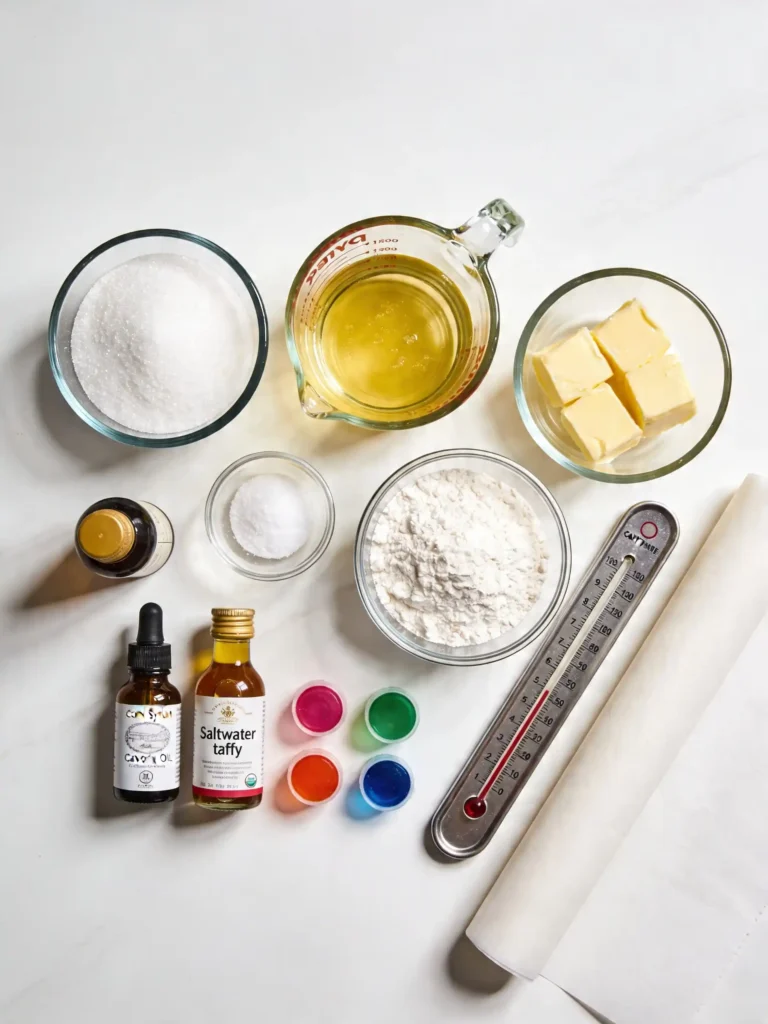
A good Homemade Saltwater Taffy Recipe depends on more than sugar alone. Light corn syrup plays a major role because it helps control crystallization and keeps the candy chewy instead of grainy.
That matters because pulled candy can turn rough fast if the sugar crystallizes in the pot. Corn syrup keeps the mixture smoother and helps the final taffy stay soft and elastic.
Cornstarch often appears in taffy recipes as part of the dusting or anti-stick process. It helps manage the sticky surface of the candy during handling and wrapping, especially if your kitchen runs warm.
Butter matters too. It adds richness and helps the candy feel smoother while also making the pulling stage a little easier.
Salt is the quiet supporting ingredient. It does not make the taffy taste salty, but it does make the sweetness feel more balanced and the flavor more complete.
Homemade Saltwater Taffy Recipe looks simple on paper, but each ingredient has a very specific job. When the balance is right, the candy stays chewy instead of turning brittle or gritty.
Flavoring Oils vs. Extracts: Getting the Ratio Right
Flavoring is where Homemade Saltwater Taffy Recipe becomes especially fun, but it is also where a lot of people accidentally overdo things. Concentrated candy oils are far stronger than standard extracts, so the amount you use has to change accordingly.
That difference matters a lot. A concentrated oil may need only about 1/2 teaspoon, while a standard extract often needs closer to 1 teaspoon to create the same noticeable flavor in the finished candy.
This is why reading the bottle matters. LorAnn-style candy oils and similar products are designed for candy work, so they taste strong and direct even in small amounts.
Standard extracts can still work beautifully, but they often bring a softer flavor. That can be nice for vanilla, peppermint, banana, or strawberry, but you usually need a little more.
I like choosing flavor based on how classic or playful I want the batch to feel. Watermelon and grape lean very nostalgic, while peppermint, vanilla, or banana can make the candy feel more old-fashioned.
Here is a simple flavor guide:
| Flavor | Standard Extract | Concentrated Oil |
|---|---|---|
| Watermelon | 1 teaspoon | 1/2 teaspoon |
| Grape | 1 teaspoon | 1/2 teaspoon |
| Banana | 1 teaspoon | 1/2 teaspoon |
To elevate the sweet profile of your sugar base, I like borrowing balance ideas from our pink salt trick. That tiny salty contrast makes many sweets taste more complete.
For another very easy batch candy project, check out our crockpot christmas candy. It is much simpler than taffy, but it scratches the same homemade candy itch.
Print
Homemade Saltwater Taffy Recipe
- Total Time: 40 minutes
- Yield: 60 pieces 1x
Description
A classic Homemade Saltwater Taffy Recipe with a chewy pulled texture, bright flavor options, and old-fashioned wrapped candy charm.
Ingredients
- 2 cups granulated sugar
- 1 1/2 cups light corn syrup
- 1/2 cup water
- 2 tablespoons butter, plus more for greasing
- 1/2 teaspoon salt
- 2 tablespoons cornstarch, optional depending on method
- 1 teaspoon extract or 1/2 teaspoon concentrated candy oil
- Food coloring, optional
- Wax paper squares for wrapping
Instructions
- Butter a baking sheet or marble slab and prepare buttered food-safe gloves.
- Combine sugar, corn syrup, water, butter, salt, and cornstarch if using in a saucepan.
- Heat gently, stirring until the sugar dissolves.
- Stop stirring once the syrup begins boiling.
- Attach a candy thermometer and cook to 250°F to 253°F, ideally 252°F.
- Remove from the heat and stir in flavoring and food coloring.
- Pour the hot mixture onto the prepared buttered surface.
- Let it cool until safe enough to handle with buttered gloves.
- Pull and stretch the candy for about 15 minutes until lighter, shinier, and opaque.
- Roll into ropes and cut into bite-size pieces with buttered kitchen shears.
- Let the pieces rest for 20 minutes.
- Wrap each piece in wax paper.
Notes
Use a reliable candy thermometer for the best texture.
Subtract about 2°F from the target temperature for every 1,000 feet above sea level.
Butter your gloves well before pulling the candy.
Let the cut taffy rest before wrapping so it sticks less to the paper.
Keep the syrup between 250°F and 253°F for the ideal chewy texture.
- Prep Time: 25 minutes
- Cook Time: 15 minutes
- Category: Candy
- Method: Stovetop / Pulled Candy
- Cuisine: American
Nutrition
- Serving Size: Per 1 piece
- Calories: 35 kcal
- Sugar: 7g
- Sodium: 20mg
- Fat: 0.5g
- Saturated Fat: 0.3g
- Unsaturated Fat: 0.1g
- Trans Fat: 0g
- Carbohydrates: 8g
- Fiber: 0g
- Protein: 0g
- Cholesterol: 1mg
The Step-by-Step Boiling and Pulling Process
Reaching the Magic 252°F Hard-Ball Stage
Temperature is everything in Homemade Saltwater Taffy Recipe. If the syrup stops too early, the candy stays too soft and sticky, and if it goes too far, the taffy hardens into something closer to glass candy.
That is why the hard-ball stage matters so much. For this recipe, the sweet spot usually lands around 250°F to 253°F, with 252°F sitting right in the center of that working range.
A reliable candy thermometer is the easiest way to stay in control. Homemade Saltwater Taffy Recipe is not the place for guessing, because a couple of degrees can shift the texture more than many people realize.
I like clipping the thermometer to the saucepan early so I can watch the syrup climb without interrupting the boil too much. Once it enters the final range, I pay close attention because it can move quickly.
The syrup should look active, glossy, and increasingly thick as it approaches target temperature. Still, the thermometer matters more than appearance once you get close.
How to Pull Taffy With Buttered Gloves
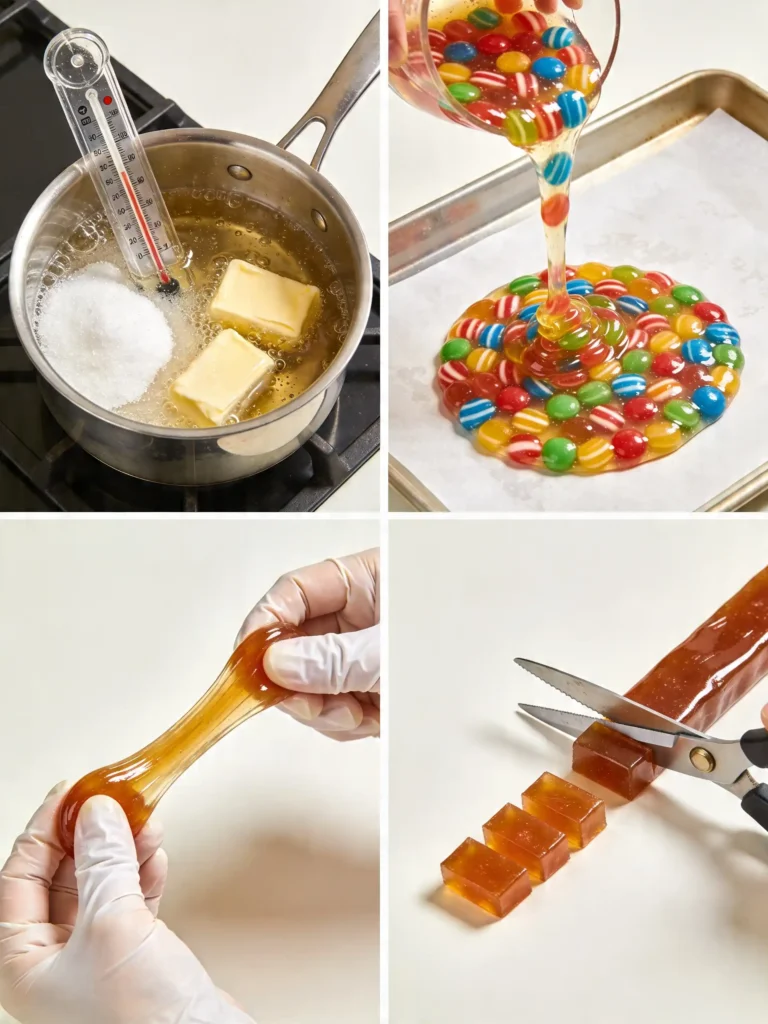
Once the syrup reaches temperature, you pour it onto a buttered baking sheet or marble slab and let it cool just enough to handle. This is the moment where Homemade Saltwater Taffy Recipe shifts from cooked candy syrup to real pulled taffy.
Pulling introduces air into the candy and changes both color and texture. What starts translucent becomes lighter, more opaque, and much more satin-like as you stretch and fold it again and again.
Chef’s Note: Buttered food-safe gloves make this process much easier than bare hands. They protect you from heat, reduce sticking, and help you keep the taffy moving smoothly during the pulling stage.
Here is the full method:
- Butter a baking sheet or marble surface well before you start cooking.
- Combine sugar, corn syrup, water, butter, salt, and cornstarch if using according to your chosen formula.
- Heat the mixture gently at first, stirring until the sugar dissolves.
- Stop stirring once the syrup begins boiling strongly.
- Clip on a candy thermometer and cook to 250°F to 253°F, ideally 252°F.
- Remove the pan from the heat and stir in flavoring and food coloring carefully.
- Pour the hot syrup onto the prepared buttered surface.
- Let it cool until it is still warm but safe enough to handle with buttered gloves.
- Begin stretching and folding the candy over itself repeatedly.
- Pull for about 15 minutes until it turns lighter, shinier, and more opaque.
- Roll the taffy into ropes.
- Cut the ropes into bite-size pieces with buttered kitchen shears or a buttered knife.
- Let the pieces rest before wrapping.
The pulling stage is the heart of Homemade Saltwater Taffy Recipe. It is also the part most people remember because it feels the most hands-on and changes the candy so dramatically.
Practice your candy-boiling instincts with our fruity homemade gumdrops. You can also sharpen your thermometer confidence by whipping up a batch of our orange chipotle citrus fire jam.
High-Altitude Adjustments and Troubleshooting
Adjusting Your Cooking Temperature for Elevation
Altitude changes how sugar syrup behaves. At higher elevations, water boils at a lower temperature, which means Homemade Saltwater Taffy Recipe needs a small adjustment if you want the final texture to stay correct.
The simplest rule is to subtract about 2 degrees from the target temperature for every 1,000 feet above sea level. That means your ideal finish temperature may be lower than 252°F if you live well above sea level.
This is one of the most helpful candy rules to understand because it explains why a recipe that worked beautifully at the beach might fail in the mountains. The syrup is not behaving badly. It is simply responding to different conditions.
If you ignore the altitude difference, the candy may overcook even when the thermometer says you hit the standard number. That is when Homemade Saltwater Taffy Recipe can turn too firm and lose its chew.
I always recommend writing down what worked in your kitchen. Candy gets easier when you start keeping track of your exact successful temperature in your own environment.
Rescuing Hard Candy or a Sticky Mess
The most common problems in Homemade Saltwater Taffy Recipe come from temperature. Too hot, and the candy hardens like a fruit chew or a Jolly Rancher. Too cool, and it stays limp, sticky, and too soft to wrap well.
That is frustrating, but it is also useful information. Candy mistakes often point very clearly to what happened.
If the taffy turned hard, it almost certainly went a little too far. If it stayed slimy or runny, it likely needed more time on the heat before it ever reached the pulling surface.
Here is a simple troubleshooting guide:
| Problem | Likely Cause | Solution |
|---|---|---|
| Candy is hard like a Jolly Rancher | It cooked past 253°F | Stop closer to 252°F or lower for altitude |
| Taffy is a runny mess | It did not reach target temperature | Cook to the full hard-ball range before pouring |
Serve this colorful, kid-friendly treat at your next summer party alongside our vibrant strawberry pizza. The cheerful colors and playful feel work beautifully together.
Wrapping, Curing, and Storage Secrets
Why You Must Let the Cut Taffy Rest
Freshly cut Homemade Saltwater Taffy Recipe still needs a short rest before wrapping. That resting time lets the surface settle slightly so the candy is less likely to stick badly to the wrapper.
I like giving the pieces about 20 minutes to rest after cutting. That short pause helps the outside feel a little more stable without making the taffy hard.
This step matters because wrapping too soon can trap extra warmth and stickiness. Then the paper clings too tightly, and the candy loses some of its clean boardwalk look.
A little patience here makes the final candy feel more polished. Homemade Saltwater Taffy Recipe should look tidy and cheerful once twisted in paper, not messy and welded to the wrapper.
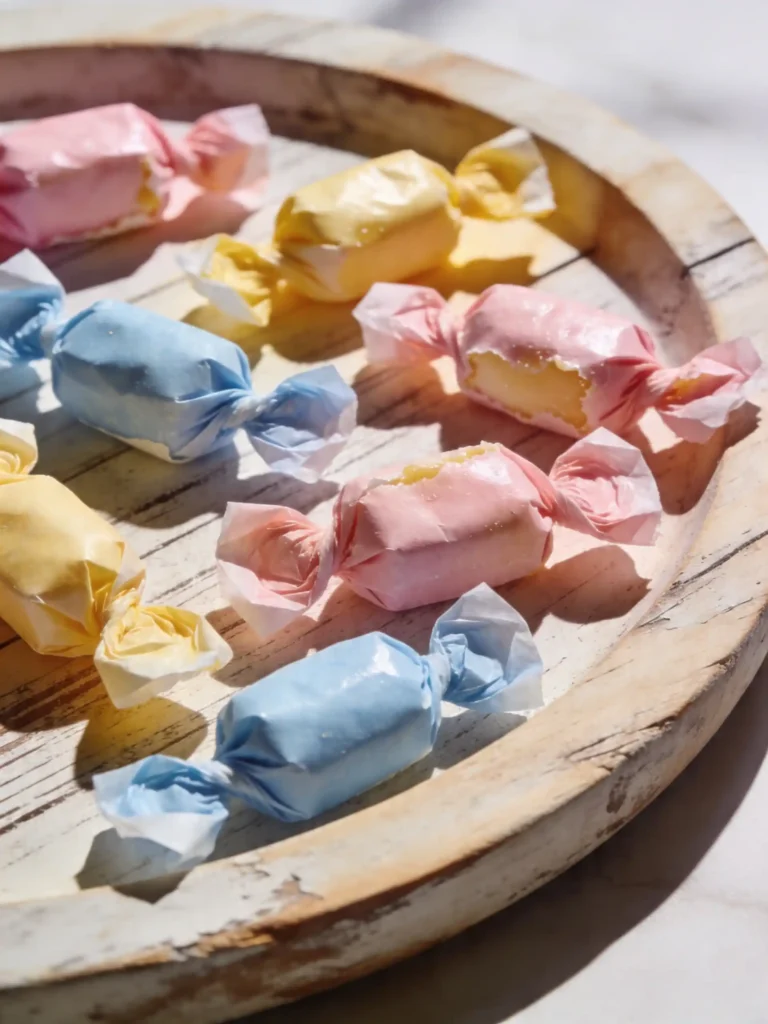
Wrapping With Pre-Cut Wax Paper Squares
Pre-cut wax paper squares make the wrapping stage much easier. They save time, help you move faster, and keep each piece looking uniform once the batch is finished.
I like to cut the wrappers before I start boiling the candy. That way, once the taffy is pulled, cut, and rested, I can go straight into wrapping without stopping to measure paper.
Twist each end firmly but gently. The goal is to secure the piece without squeezing the candy out of shape.
Homemade Saltwater Taffy Recipe stores best when each piece is wrapped individually. That keeps the candy cleaner, helps prevent sticking, and makes it much easier to gift or serve.
Need a refreshing drink to pair with your boardwalk-style candy? Try our easy mocktail recipes for summer. Cool down after pulling hot sugar with a bowl of our refreshing watermelon sorbet recipe.
Frequently Asked Questions
What is the difference between regular taffy and saltwater taffy?
Saltwater taffy usually refers to the classic boardwalk-style pulled candy made with sugar, corn syrup, butter, and a little salt. The salt is there for balance, not to make the candy taste salty.
Why is it called salt water taffy?
The name comes from boardwalk candy history, not from actual seawater in the recipe. Homemade Saltwater Taffy Recipe uses regular ingredients, and the “saltwater” label is more cultural than literal.
Can I make salt water taffy without corn syrup?
You can find alternative formulas, but corn syrup helps prevent crystallization and keeps the texture chewy. Without it, Homemade Saltwater Taffy Recipe becomes harder to control.
What’s the secret to chewy taffy?
The biggest secret is reaching the correct temperature, then pulling the candy long enough to create the right texture. Homemade Saltwater Taffy Recipe needs both steps working together.
How do I keep it from sticking to the wrapper?
Let the cut pieces rest before wrapping, and use pre-cut wax paper. Slightly cooled taffy wraps much more neatly than candy that is still too warm on the surface.
Does altitude affect how candy cooks?
Yes, it absolutely does. At higher elevations, Homemade Saltwater Taffy Recipe may need a lower final temperature because water boils at a lower point.
Conclusion
Homemade Saltwater Taffy Recipe is one of those candy projects that feels both fun and deeply rewarding. It brings together sugar science, old-fashioned candy charm, and the very satisfying hands-on process of pulling and wrapping your own sweets.
The biggest keys are simple but important. Watch the thermometer closely, adjust for altitude if needed, butter your gloves, pull the candy long enough, and let the pieces rest before wrapping.
Once you make a batch successfully, Homemade Saltwater Taffy Recipe becomes much less intimidating and much more fun to repeat. For more shareable sweets, package up a tin of our peppermint oreo white chocolate bark.
If you prefer your mint and chocolate flavors chilled instead of pulled, dive into our no bake mint chocolate pie. It makes a great contrast to the chewy, old-fashioned feel of taffy.
For daily recipes and helpful cooking tips. Follow along: Chef Adriana on Facebook